
TNV Series · TNV2 / TNV3 / TNV6
TNV Series IP Thermal Camera with AI for Vehicles and Boats
A network thermal camera that detects people, vehicles and animals on board and streams over Ethernet. Plug it into an NVR, a video platform, an Android tablet or your own control software; no separate AI box is needed. It has no analog or AHD video output.
- Thermal256 × 192 / 384 × 288 / 640 × 512, 12 μm VOx, ≤ 40 mK
- Lenses2 to 13 mm, horizontal field of view 18° to 110°
- NetworkRJ45 Ethernet, RTSP, ONVIF, DHCP; Wi-Fi optional
- AIPeople, vehicles and animals, distance, custom alarm zones
- AI rangePerson up to 100 m, vehicle up to 200 m, animal up to 60 m
- Alarms3.3 V output, speaker, alarm in the browser
- BuildIP67, −30 to +70 °C, DC 12 V, under 6 W, about 300 g
Request the PDF datasheet and harness drawing. Made by iSun Digitech Limited in Shenzhen; thermal R&D by VERYTEK AI Tech Limited. Specifications from the TNV Series datasheet, October 2026.
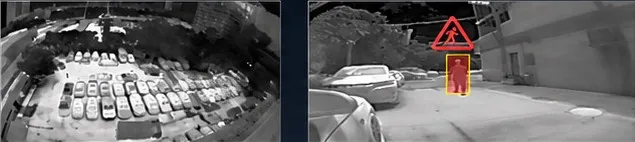
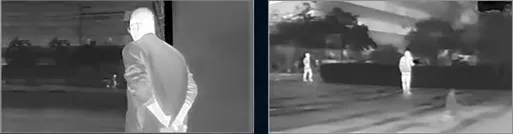
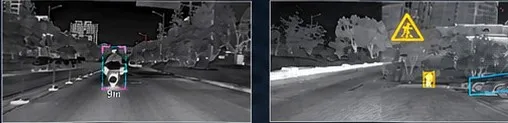
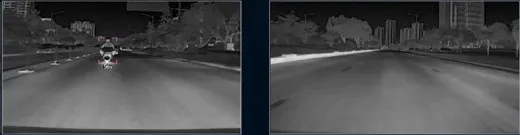
What each TNV IP thermal camera model sees
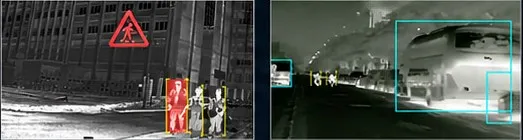
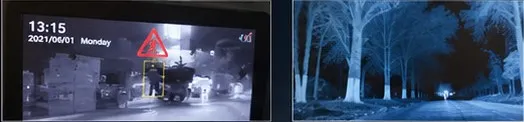
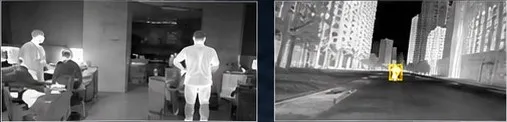
Sample images supplied with the datasheet, two per model. Boxes and warning icons are the camera's AI overlays. Wide lenses show more of the scene; narrow lenses show targets further away in more detail.


What an AI network thermal camera does on board
Video, detection and alarms all come from the IP thermal camera itself. That keeps the wiring to one network cable and one alarm lead.
- Streams thermal video over RTSP, and joins ONVIF network video systems, so the image appears in the recorder or software you already use.
- Detects people, vehicles and animals with a 3 TOPS NPU and estimates how far away they are, with self-calibration for ranging.
- Watches zones you draw yourself, and links several zones so one event can trigger the right alarm.
- Alerts through a 3.3 V high-level output for a buzzer, light or controller, through the alarm speaker, and in the browser interface.
- Records locally and takes firmware updates remotely, which matters once cameras are spread across a fleet.
Nine TNV IP thermal camera models: lens, field of view and AI range
Pick resolution and lens together. A wide lens covers the area around a slow vehicle; a narrow lens reaches further but sees a smaller slice of the scene.
| Model | Resolution | Lens | Field of view (H × V) | AI person | AI vehicle | AI animal | Window defrost |
|---|---|---|---|---|---|---|---|
| TNV2-2 | 256 × 192 | 2 mm | 100° × 70° | 15 m | 30 m | 10 m | No |
| TNV2-4 | 256 × 192 | 4 mm | 45° × 33° | 60 m | 100 m | 40 m | Yes |
| TNV2-9.1 | 256 × 192 | 9.1 mm | 18° × 13° | 100 m | 200 m | 60 m | Yes |
| TNV3-4 | 384 × 288 | 4 mm | 66° × 55° | 70 m | 120 m | 45 m | Yes |
| TNV3-9.1 | 384 × 288 | 9.1 mm | 29° × 22° | 100 m | 200 m | 60 m | Yes |
| TNV6-4 | 640 × 512 | 4 mm | 110° × 88° | 50 m | 90 m | 35 m | No |
| TNV6-4.6 | 640 × 512 | 4.6 mm | 95° × 76° | 60 m | 100 m | 40 m | No |
| TNV6-9.1 | 640 × 512 | 9.1 mm | 45° × 37° | 80 m | 200 m | 50 m | Yes |
| TNV6-13 | 640 × 512 | 13 mm | 34° × 27° | 100 m | 200 m | 60 m | Yes |
AI ranges are reference values from the datasheet, not guaranteed alarm distances. Target size, thermal contrast, weather, mounting height and angle all change the result, so test on your own vehicle or vessel.
Reference night-observation range
| Model | TNV2-2 | TNV2-4 | TNV2-9.1 | TNV3-4 | TNV3-9.1 | TNV6-4 | TNV6-4.6 | TNV6-9.1 | TNV6-13 |
|---|---|---|---|---|---|---|---|---|---|
| Person | 40 m | 94 m | 236 m | 150 m | 214 m | 85 m | 108 m | 214 m | 306 m |
| Vehicle | 70 m | 138 m | 347 m | 240 m | 315 m | 140 m | 159 m | 315 m | 451 m |
| Boat | 200 m | 400 m | 1,000 m | 400 m | 1,000 m | 400 m | 480 m | 1,000 m | 1,400 m |
How far an operator can see a target on screen: a person taller than 1.7 m, a vehicle wider than 2.5 m, or a boat more than 5 m above the water. This is a viewing distance, not an AI or alarm distance, and no standard test criterion applies.
Which output do you need? TC, TA or TNV
All three series use the same 256, 384 and 640 detectors and the same nine lenses. They differ in how the image leaves the camera and whether the camera runs AI.
| Series | Video output | On-camera AI | Data and alarms | Power | Size and weight | Best fit |
|---|---|---|---|---|---|---|
| TC Series | CVBS (PAL) or USB | None: thermal image only | None | 9 to 24 V (CVBS) or 5 V (USB), under 2 W | 52 × 42 × 42 mm, 180 g | Boats and vehicles with a monitor, fish finder or display that takes composite video |
| TA Series | AHD 720p, optional 1080p | People, cyclists, motorcycles, vehicles | RS485 (transmit only), alarm speaker | 9 to 24 V, under 7 W | 64 × 75 × 58 mm, about 300 g | Trucks, buses and mining fleets with an AHD monitor or DVR and a warning terminal |
| TNV Series | Ethernet: RTSP, ONVIF | People, vehicles, animals, with distance | 3.3 V alarm output, speaker, browser alarm | 12 V, under 6 W | About 300 g | Network video systems, NVRs, robots, unmanned boats and special vehicles |
| Detector | Uncooled VOx microbolometer, 12 μm pixel pitch |
|---|---|
| Resolution options | 256 × 192 (TNV2) / 384 × 288 (TNV3) / 640 × 512 (TNV6) |
| Spectral band | 8 to 14 μm (LWIR) |
| NETD | ≤ 40 mK at 25 °C, F/1.0 |
| Lenses | 2 / 4 / 4.6 / 9.1 / 13 mm, horizontal field of view 18° to 110° |
| Processing | On-camera NPU, listed as 3 TOPS |
| AI detection | People, vehicles and animals, with distance estimation and self-calibration |
| Alarm zones | Custom detection regions with multi-region linkage |
| Network | RJ45 Ethernet; RTSP, ONVIF and DHCP |
| Wireless | Wi-Fi optional, by project |
| Alarm outputs | 3.3 V high-level output, alarm speaker, alarm in the browser interface |
| Image | White-hot by default, 7 palettes; brightness and contrast adjustment |
| Recording and updates | Local recording; remote firmware upgrade |
| Android | Wired network connection to an Android device through a companion app |
| Window defrost | On all lenses except the 100°, 110° and 95° wide views |
| Housing | Sealed, IP67 |
| Operating / storage temperature | −30 °C to +70 °C / −35 °C to +75 °C |
| Power | DC 12 V, under 6 W |
| Weight | About 300 g |
What the TNV IP thermal camera does not do
- No analog or AHD video. For a CVBS monitor see the TC Series; for AHD see the TA Series.
- The listed input is 12 V only; 24 V vehicles need a converter.
- ONVIF support does not mean every NVR feature works; test events and profiles on your platform.
- Distance is estimated from the image, not measured by laser.
- No calibrated temperature measurement.
- It does not brake, steer or navigate, and it is not a certified vehicle safety system.
- The three widest lenses have no defrost window.
Wiring the IP thermal camera
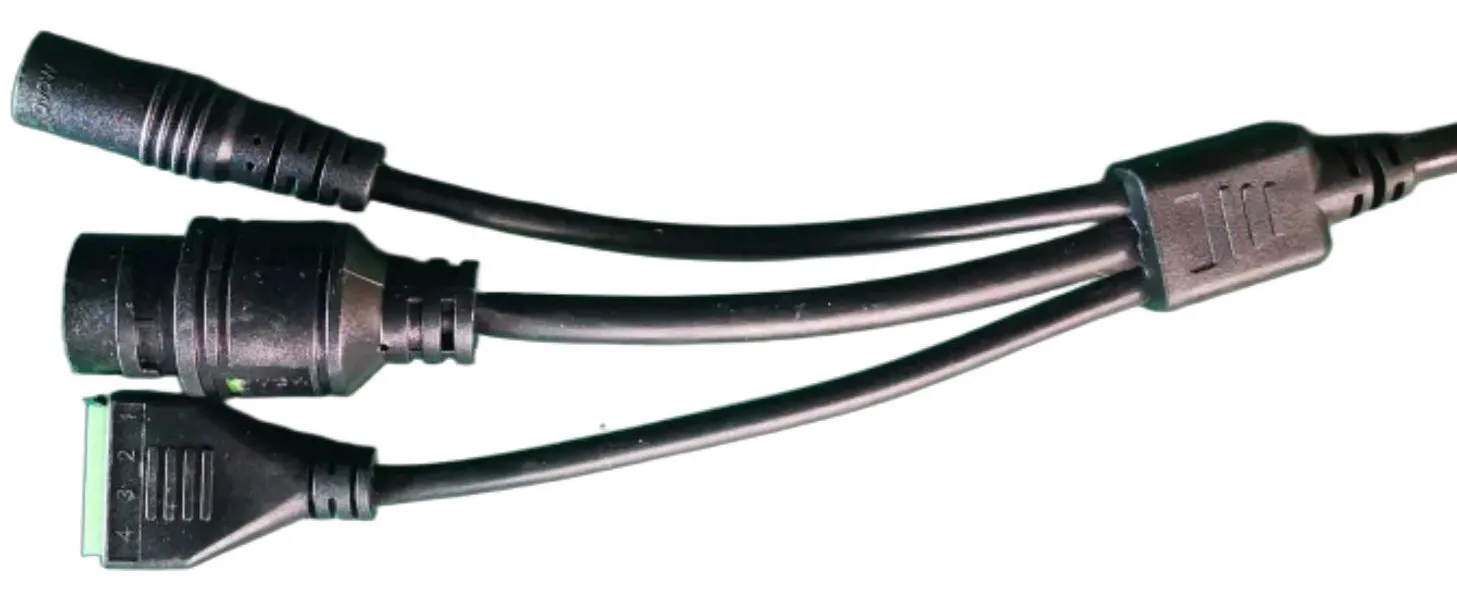
The harness carries power, the network and one alarm connector.
- DC 12 V power input
- RJ45 Ethernet port for video, setup and alarms
- Pin 1: alarm output, 3.3 V high level
- Pin 2: ground
- Pin 3 and 4: alarm speaker + and −
Confirm the connector types, harness length and full pinout against the hardware document in your quotation.
Five steps to a working installation
- Mount the thermal IP camera outside, with a clear view; glass and plastic windows block thermal imaging.
- Connect 12 V power and Ethernet. DHCP gives the camera an address on most networks.
- Add the RTSP stream or the ONVIF device to your NVR, platform or Android app.
- Draw the alarm zones, choose people, vehicles or animals, and calibrate distance on the vehicle.
- Wire the 3.3 V output or speaker, then test detections and alarms in real conditions.
Where the IP thermal camera is used
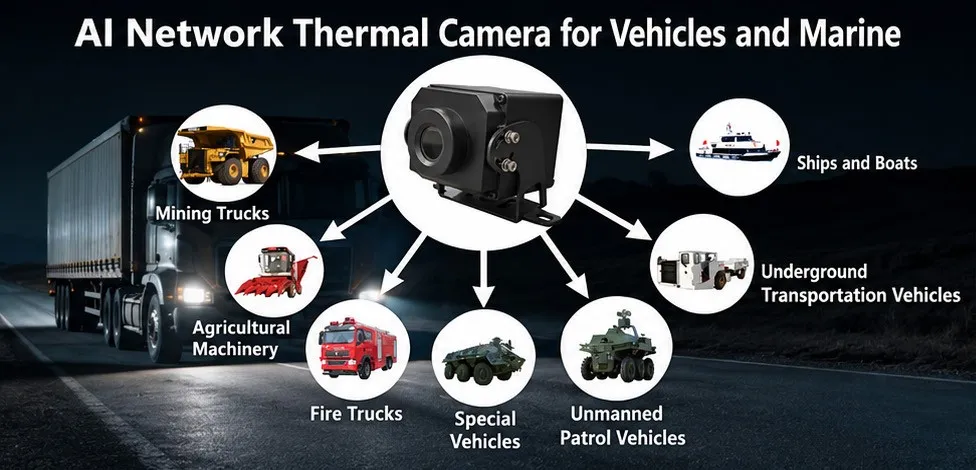
- Vehicles: mining and commercial trucks, fire, patrol, border and railway vehicles, and mobile command units.
- Boats: fishing boats, small commercial vessels and unmanned surface vessels watching for people, vessels and objects at night.
- Robots: unmanned ground vehicles, robot dogs and inspection platforms that need a thermal channel over Ethernet.
- Security: vehicle patrol systems and remote sites where the camera can raise its own alarms.
What to send us for an IP thermal camera quote
- Vehicle, vessel or robot type, and where the camera will be mounted
- Required resolution, or the scene width and target distance you need
- The NVR, software or app that will receive the stream
- Supply voltage and the alarm device you will connect
- Sample quantity, expected yearly volume and timeline
Questions about the TNV Series IP thermal camera
What is the difference between the TNV and TA Series?
Both run AI on the camera and use the same detectors and lenses. The TNV is an IP thermal camera: it sends video over Ethernet (RTSP, ONVIF) and adds animal detection; the TA sends AHD video to a monitor or DVR and detection data over RS485. Choose by the system you are connecting to.
Will this IP thermal camera work with my NVR or video management software?
It streams over RTSP and supports ONVIF, so most network recorders and VMS platforms can add it. ONVIF profiles and event handling differ between platforms, so test a sample on your exact NVR or software before a volume order.
Can I view the camera on an Android tablet?
Yes. The camera connects to an Android device over a wired network link through a companion app. Wi-Fi is available as a project option.
Does the TNV Series detect animals?
Yes. The on-camera AI detects people, vehicles and animals. Reference AI ranges for animals run from 10 m on the 2 mm lens to 60 m on the 9.1 and 13 mm lenses.
What is the difference between night range and AI range?
Night range is how far an operator can see a target on screen. AI range is how far the camera classifies a target and can raise an alarm. On the TNV6-13, for example, a vehicle is visible at 451 m but the AI range is 200 m.
Can I power it from a 24 V truck?
The input is listed as DC 12 V. On 24 V vehicles, plan a DC-DC converter or tell us your supply and we will confirm the wiring for your project.
Can the network thermal camera be used on a boat?
Yes, it is used on fishing boats, small commercial vessels and unmanned surface vessels. The housing is IP67; plan connector sealing, cable routing and corrosion protection for the vessel. Marine type approval is not part of the standard product.
Do I need a separate AI computer?
Not for detection, distance estimation and alarm zones; they run on the camera. Your own computer is only needed for functions beyond those, such as navigation or fleet software.
Can the IP thermal camera brake, steer or measure temperature?
No. It provides thermal video, detections and alarms to other systems. It is not a calibrated temperature-measurement camera and does not control the vehicle or vessel.
Tell us the vehicle, vessel or robot and the system it joins. We will recommend a TNV IP thermal camera.
Share your company, target market, vehicle types and expected quantity. We reply with a configuration, sample terms and pricing.