
Three technologies sold as "night vision"
Search for car night vision and you will find three different products under the same name. They are built for different jobs, and buyers who mix them up end up with the wrong expectations.
| Thermal camera | Near-infrared night vision | Night vision dash cam | |
|---|---|---|---|
| What it detects | Heat (long-wave infrared, 8 to 14 μm) | Reflected near-infrared from its own IR lamps | Visible light, sometimes near-infrared |
| Needs light | No | Yes, its own IR illumination | Yes, headlights or street lighting |
| Oncoming headlight glare | Not blinded | Can be washed out | Often washed out |
| Pedestrian beyond the headlights | Visible by body heat | Only within IR lamp range | Usually not visible |
| Through the windshield | No, mounted outside | Depends on the product | Yes |
| Main purpose | Seeing and warning | Seeing at short range | Recording evidence |
Thermal: images heat, ignores glare
A thermal camera measures the temperature of surfaces and shows the difference as an image. People, animals and running vehicles are warmer than the road around them, so they stand out in complete darkness. Because it does not use visible light, an oncoming high beam does not wash out the picture.
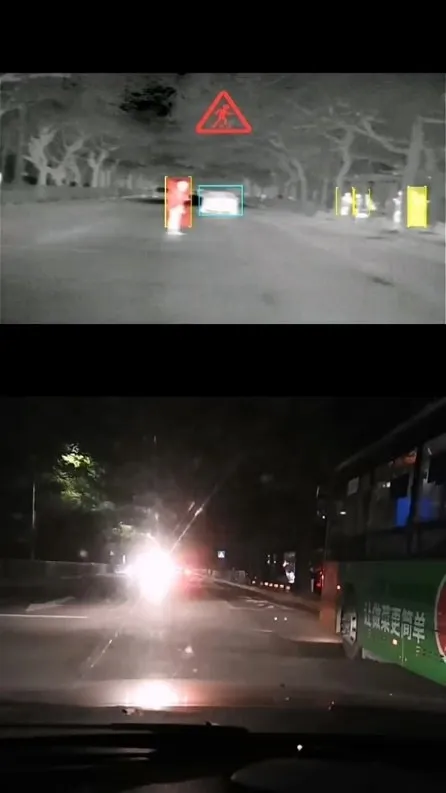
The limits: thermal images show temperature, not colour, so signs and lane paint are hard to read. On warm nights, when the air is near body temperature, contrast drops. Dense fog and heavy rain shorten the range.
Automotive infrared camera (near-infrared): a torch you cannot see
Near-infrared night vision lights the road with infrared lamps and records the reflection with a sensitive camera. It shows more texture than thermal, but its range is limited to how far its own lamps reach, and it can be dazzled by strong lights.
Night vision dash cams: recording, not detecting
Most products called night vision dash cams are low-light video cameras behind the windshield. They are good at recording number plates and events inside the headlight beam for insurance. They do not reveal a person in the dark beyond that beam.
Night vision camera for car: which fits your customers
For drivers on unlit rural roads, where the risk is a pedestrian, cyclist or animal outside the headlights, thermal is the only option of the three that detects them by body heat. That is why thermal systems pair the image with AI recognition and alerts. As an automotive infrared camera manufacturer, we build the long-wave (thermal) type. See the configurations and the resolution guide.